





For most of the past half-century, type 2 diabetes was treated as a one-way road. You were diagnosed, you started medication, and over time the medication intensified. The goal was control, not reversal. The possibility of reversal was not seriously entertained in mainstream clinical practice.
That has changed. The evidence now clearly establishes that type 2 diabetes can go into remission — defined as maintaining normal blood glucose levels without glucose-lowering medication. What the evidence also makes clear, and what tends to get lost in popular coverage of this topic, is that remission does not apply equally to everyone. The story of who achieves it, and why, is more clinically useful than the headline.
Why Remission Is Biologically Possible at All
Understanding why type 2 diabetes can go into remission requires understanding what causes it in the first place — and the answer is more specific than most people realise.
The prevailing scientific explanation is called the twin cycle hypothesis, developed by Professor Roy Taylor at Newcastle University over more than a decade of research. The hypothesis proposes that type 2 diabetes is caused by the accumulation of excess fat inside two organs: the liver and the pancreas.
Here is how the cycle works. When a person consistently takes in more calories than they expend, the body’s fat storage systems — primarily under the skin — can reach a saturation point. At that point, excess fat begins to accumulate in the liver. This causes the liver to become resistant to insulin’s signals and to overproduce glucose. As liver fat continues to accumulate, it spills over into the bloodstream and deposits in the pancreas. Fat inside the pancreas impairs the beta cells — the cells responsible for producing insulin — causing them to function poorly.
The result is the combination of insulin resistance and insufficient insulin production that defines type 2 diabetes.
The critical insight of the twin cycle hypothesis — confirmed by multiple studies including the DiRECT trial — is that this process is reversible. Sufficient weight loss removes the excess fat from both organs. Liver function normalises within days. Beta cell function recovers over weeks to months. Blood glucose returns to normal — and stays there, as long as the weight loss is maintained.
This is the biological basis for remission. It is not a lifestyle improvement that happens to lower blood sugar. It is the removal of the underlying cause.
What the DiRECT Trial Established
The most rigorous clinical test of this principle is the DiRECT trial — the Diabetes Remission Clinical Trial — conducted across primary care practices in Scotland and England.
DiRECT enrolled 298 adults with type 2 diabetes diagnosed within the previous six years, BMI between 27 and 45, and no insulin use. The intervention group followed a structured total diet replacement programme — soups and shakes providing approximately 825–853 calories per day — for 12 to 20 weeks, followed by gradual food reintroduction and long-term support for weight maintenance.
The results were striking. At 12 months, 46% of the intervention group had achieved remission. At 24 months, 36% remained in remission. A 2024 extension published in the Lancet Diabetes & Endocrinology followed participants to five years — 13% were still in remission.
The five-year figure deserves honest framing. It means that roughly one in eight people who completed the programme were still in remission five years later. That is significantly lower than the one-year figure. But it also represents something that the previous clinical consensus said was not possible at all: sustained, medication-free normal blood glucose in people with established type 2 diabetes.
Weight loss was the single strongest predictor across all time points. For every additional kilogram lost, the probability of one-year remission increased by approximately 24%. Those who lost 15 kg or more achieved remission rates of around 86% at 12 months.
The Indian Evidence
The DiRECT trial was conducted in a predominantly white European population in UK primary care. The question of whether the same results apply in Indian patients — who develop type 2 diabetes at lower BMI, younger age, and with a distinct pattern of fat distribution — is clinically important.
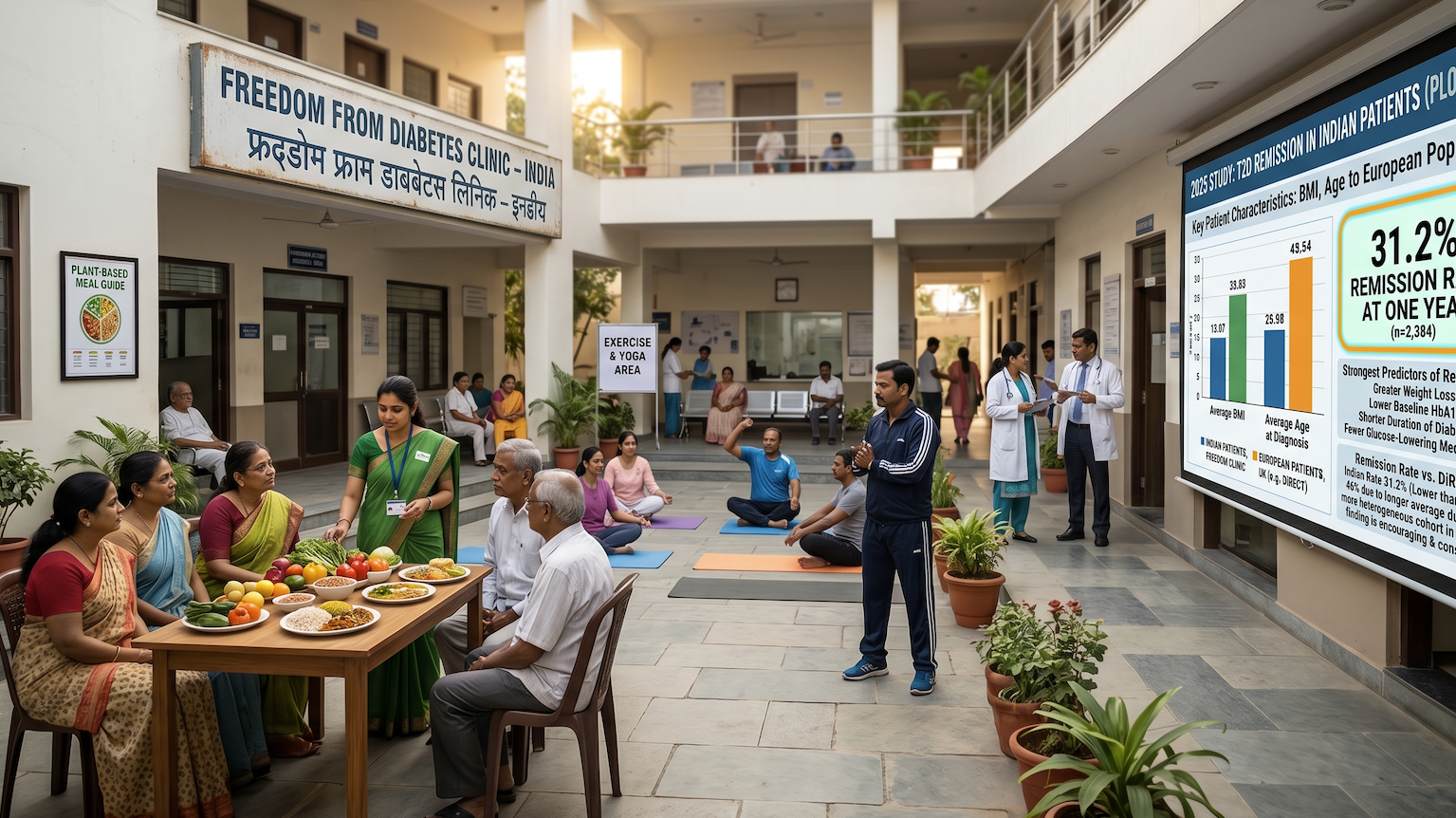
A 2025 study published in PLOS ONE analysed 2,384 Indian patients enrolled in an intensive lifestyle intervention programme — combining plant-based diet, physical activity, and stress management — at the Freedom from Diabetes Clinic across India. Remission was defined using the same HbA1c criterion as DiRECT.
The remission rate at one year was 31.2%. Predictors closely mirrored the DiRECT findings: greater weight loss, lower baseline HbA1c, shorter diabetes duration, and fewer glucose-lowering medications at baseline were the strongest factors associated with remission.
31.2% is lower than DiRECT’s 46% — but this cohort included patients with longer average diabetes duration and more heterogeneous clinical profiles than the tightly selected DiRECT population. The finding is encouraging and directionally consistent: structured, intensive lifestyle intervention produces meaningful remission rates in Indian patients.
Who Remission Is — and Is Not — Realistic For
This is the section of the conversation that most popular coverage skips. The DiRECT trial had strict inclusion criteria. Most patients presenting with type 2 diabetes in Indian clinics do not fit them.
The evidence is consistent on the predictors of remission across multiple studies and intervention types:
Shorter diabetes duration — remission rates decline substantially beyond six years of diagnosis. After ten years, the chance of achieving remission is considerably lower. Beta cells that have been suppressed or damaged for a longer period have less functional reserve to recover.
Lower baseline HbA1c — patients with HbA1c closer to the diagnostic threshold respond better than those with significantly elevated levels at the time of intervention.
No prior insulin therapy — insulin use is a marker of more advanced beta cell failure. The underlying mechanism of remission — fat removal allowing beta cell recovery — depends on those cells having residual function to restore.
Greater weight loss — the relationship between weight loss and remission is dose-dependent. Meaningful remission is associated with losses of 10 kg or more. This level of sustained weight loss is difficult to achieve and maintain without structured support.
Fewer glucose-lowering medications — patients on multiple agents are more likely to have progressed beyond the point where beta cell recovery is achievable through weight loss alone.
For patients who do not meet these criteria — those with long-standing diabetes, high HbA1c, insulin dependence, or limited capacity for sustained weight loss — remission is not a realistic near-term goal. The appropriate focus remains optimisation of management: protecting cardiovascular and renal health, minimising complications, and maintaining quality of life. That is a legitimate and important clinical goal. It is not a lesser one.
What Remission Actually Involves

It is worth being direct about what achieving remission requires, because the phrase “reversing diabetes” in popular media often implies a simpler process than the evidence describes.
The DiRECT programme involved 12 to 20 weeks of total diet replacement — consuming only formula products providing around 800 calories per day. This is a medically supervised, highly structured intervention. It is not a dietary adjustment. It requires clinical oversight, behavioural support, and a structured plan for food reintroduction.
Bariatric surgery achieves higher and more durable remission rates — around 37.5% at three years in the ARMMS-T2D trial — through a different mechanism: more rapid and substantial weight loss combined with hormonal changes that improve insulin sensitivity. It is effective for eligible patients but carries surgical risk and is not appropriate for everyone.
Newer pharmacological agents — particularly GLP-1 receptor agonists and the dual agonist tirzepatide — produce sufficient weight loss in some patients to approach remission territory. A 2024 meta-analysis found that tirzepatide produces a mean weight reduction of approximately 8.5 kg. Whether this translates to durable remission at the same rate as intensive dietary intervention remains under active investigation.
In all cases, maintaining remission depends on maintaining weight loss. Weight regain is associated with return of diabetes. This is the most challenging aspect of the evidence — not achieving remission, but sustaining the conditions that allow it to persist.
The Bottom Line
Type 2 diabetes remission is real, biologically grounded, and clinically achievable for a specific subset of patients — primarily those diagnosed recently, with lower HbA1c, no insulin dependence, and the capacity to achieve and sustain significant weight loss.
For that subset, the opportunity is genuine and the window is time-limited. The evidence is clear that earlier intervention — in the first few years after diagnosis — produces meaningfully better outcomes than the same intervention applied later.
For the majority of patients with established, longer-duration type 2 diabetes, remission is not the primary goal. But the same principles — weight management, metabolic monitoring, and reducing the burden of ectopic fat — remain clinically relevant to slowing progression and reducing complications.
The question is not whether diabetes can be reversed. It is whether the right patients are being identified early enough for that reversal to be possible.
📚 References:
Lean et al. Lancet, 2018. (DiRECT 1-year)
Lean et al. Lancet Diabetes Endocrinol, 2019. (DiRECT 2-year)
Lean et al. Lancet Diabetes Endocrinol, 2024. (DiRECT 5-year extension)
Tripathi et al. PLOS ONE, 2025. (Indian cohort)
Rothberg et al. Diabetologia, 2024.
Taylor R. Journal of Internal Medicine, 2021. (Twin cycle hypothesis)
For assessment and management of type 2 diabetes — including evaluation of remission candidacy — SDDM Hospital’s Diabetology and Internal Medicine departments are available at +91-191-2464637 or sddm.hospital.
This article is for general educational purposes and does not constitute medical advice. Please consult a qualified healthcare professional for individualized assessment.
SDDM Hospital, Jammu Multi-Specialty Care | Paediatrics | Diabetology | Internal Medicine 📍 Channi Himmat, Jammu | 📞 +91-191-2464637 | 🌐 sddm.hospital
If you have a diabetes concern, consult our Diabetology department at SDDM Hospital, Jammu.
