






Urinary tract infections are among the most common bacterial infections in the world — second only to respiratory infections in frequency. Over 150 million cases are diagnosed globally each year. Most people have experienced one, know someone who has, or have given or received the standard advice: drink more water, wipe front to back, don’t hold it in.
Some of that advice is well-founded. Some of it has just been directly contradicted by the most current clinical guidelines. Knowing the difference matters — particularly for anyone dealing with recurrent infections.
What a UTI Actually Is

A urinary tract infection occurs when bacteria — in the overwhelming majority of cases, Escherichia coli from the gut — enter the urinary tract and establish an infection. E. coli accounts for 70–80% of community-acquired UTIs. The bacteria are not foreign to the body; they are normal residents of the digestive system. The problem arises when they colonise an environment they are not supposed to be in.
The urinary tract includes the urethra, bladder, ureters, and kidneys. Most UTIs are lower tract infections — confined to the urethra and bladder — and produce the classic symptoms: burning or pain on urination, frequent urgent need to urinate, cloudy or strong-smelling urine, and sometimes lower abdominal discomfort. When infection ascends to the kidneys, it becomes pyelonephritis — a more serious condition requiring prompt treatment.
Why Women Are Affected More Often — and What That Actually Means
The gender disparity in UTI rates is significant and well-documented. Women are affected at approximately three times the rate of men during reproductive years. The primary reason is anatomical: the female urethra is shorter — approximately 4 cm compared to 20 cm in men — and positioned in closer anatomical proximity to both the vaginal opening and the rectum, where gut bacteria naturally reside.
This proximity means bacteria have a shorter distance to travel to reach the bladder. It is a structural feature, not a hygiene failure. No amount of washing, wiping technique, or behavioural modification changes the underlying anatomy.
This distinction matters because a significant part of UTI prevention advice has historically been framed around hygiene practices — implying that infections are a consequence of inadequate cleanliness. The evidence does not support this framing.
What Actually Drives UTI Risk
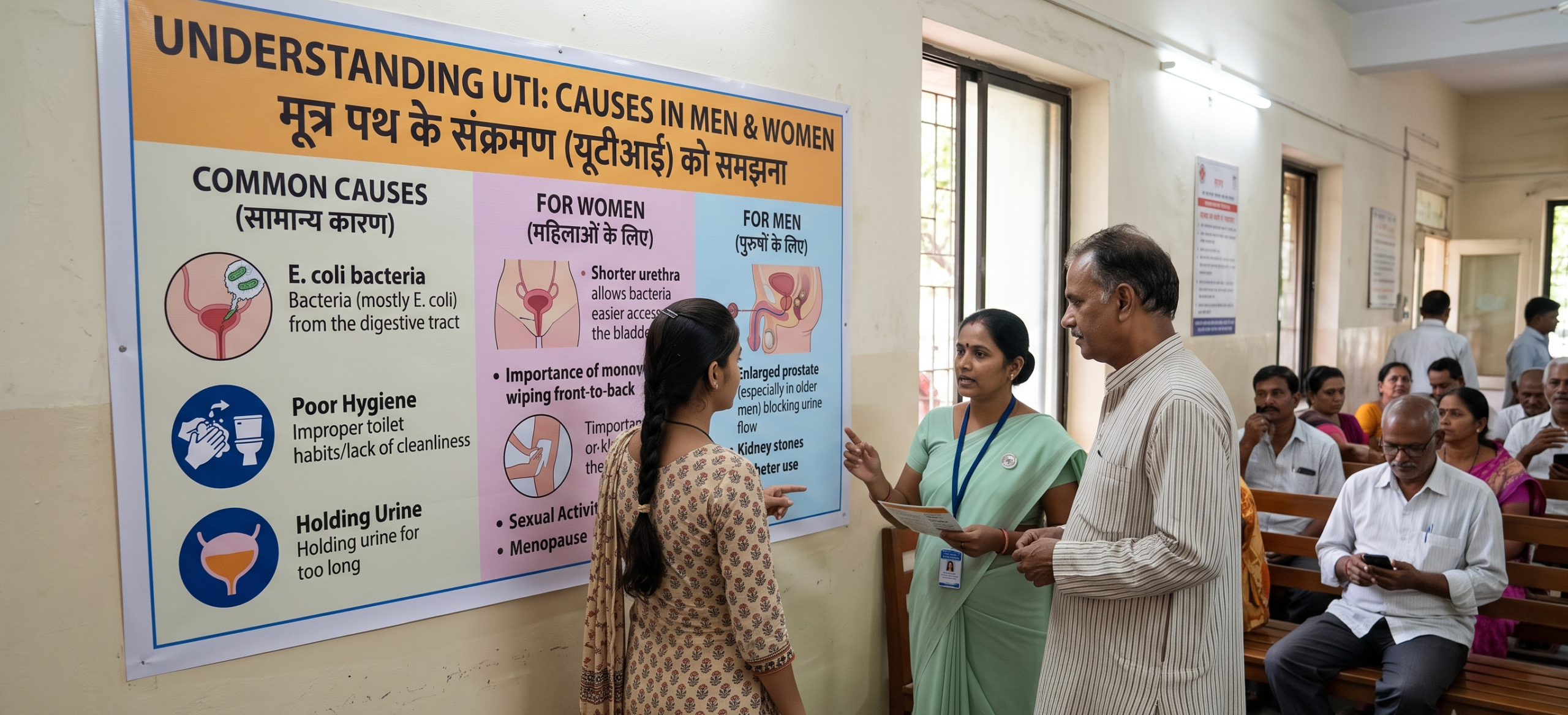
Beyond anatomy, several factors consistently show up in the evidence as genuine UTI risk drivers.
Sexual activity is the most significant modifiable risk factor for premenopausal women. Sexual intercourse introduces bacteria into the periurethral area and can mechanically facilitate their entry into the urethra. This is not specific to any particular partner or practice — it is a mechanical consequence of the anatomy involved. The association between sexual activity and UTI onset is well-established, which is why post-coital UTIs are a recognised clinical pattern.
Contraceptive method plays a role that is frequently underappreciated. Spermicide use — whether alone or with barrier contraceptives — has a documented association with increased UTI risk. The mechanism is indirect: spermicides disrupt the vaginal microbiome by reducing Lactobacillus colonisation. Lactobacilli maintain an acidic vaginal environment that inhibits the growth and spread of pathogens including E. coli. When this population is reduced, periurethral bacterial colonisation increases.
Hydration is one of the most robustly supported preventive factors. Adequate urine flow mechanically flushes bacteria from the urinary tract before they can establish an infection. A randomised controlled trial (Hooton et al., JAMA Internal Medicine, 2018) specifically examining women with recurrent UTIs found that increasing water intake by 1.5 litres per day reduced mean annual UTI episodes from 3.2 to 1.7 — approximately a 48% reduction over 12 months. The effect size is clinically meaningful.
Postmenopausal estrogen decline is a major and underappreciated risk factor. Estrogen supports vaginal Lactobacillus colonisation and maintains the integrity of urethral and vaginal tissues. After menopause, the reduction in estrogen leads to atrophic changes in the vaginal and periurethral tissues and a shift in the vaginal microbiome that significantly increases susceptibility to UTIs. This is why postmenopausal women experience a sharp rise in UTI frequency — and why vaginal estrogen therapy is an evidence-based prevention strategy for eligible patients.
Diabetes increases UTI risk through multiple mechanisms: elevated urinary glucose provides a growth medium for bacteria, immune response is compromised, and bladder emptying may be incomplete due to autonomic neuropathy.
Urological structural factors — including incomplete bladder emptying, urinary tract anomalies, and in men, benign prostatic hyperplasia — create conditions where urine pools and bacteria can multiply. A UTI in a man, particularly in the absence of a clear precipitating factor, should prompt investigation for an underlying structural or urological cause.
Where Conventional Advice Is Being Revised
The 2025 AUA/CUA/SUFU Clinical Guideline on Recurrent Uncomplicated UTIs in Women reviewed the evidence base for lifestyle modifications commonly recommended to patients. The findings challenge several long-standing pieces of standard advice.
Front-to-back wiping, pre- and post-coital voiding, avoidance of hot tubs and baths, tampon use, and douching — all practices that have been recommended by clinicians and public health messaging for decades — were found to have no demonstrable role in recurrent UTI prevention based on the available case-control data.
This does not mean hygiene is irrelevant. It means these specific practices, when evaluated against the evidence, do not reduce UTI frequency in women who already follow basic hygiene standards. The emphasis placed on them in clinical conversations has likely displaced attention from factors with stronger evidence — primarily hydration, microbiome support, and for postmenopausal women, vaginal estrogen.
Cranberry products occupy a more nuanced position. Some trials have shown modest reductions in UTI frequency with cranberry supplementation; others have not. The proposed mechanism — proanthocyanidins preventing bacterial adhesion to the urothelium — is biologically plausible, but effect sizes across studies are inconsistent. Current guidelines describe cranberry as potentially beneficial for some patients rather than a universally recommended intervention.
When to Seek Evaluation — and What It Should Include
A single uncomplicated UTI in a healthy premenopausal woman is generally treated empirically with antibiotics based on local resistance patterns. What warrants more thorough evaluation:
Recurrent UTIs — defined as two or more episodes in six months or three or more in a year — should not be managed as isolated events. They indicate a pattern requiring investigation of underlying risk factors, urine culture with sensitivity testing to guide antibiotic choice, and assessment of whether structural, hormonal, or microbiome-related factors are contributing.
UTIs in men are always worth investigating further. The male urinary tract’s anatomical design makes uncomplicated UTIs relatively uncommon in younger men. When they occur, a structural or urological explanation should be considered.
UTIs with fever, loin pain, or systemic symptoms suggest upper tract involvement and require prompt medical attention — self-treatment or delayed presentation risks progression to serious kidney infection.
Urine culture — not just a dipstick or symptomatic diagnosis — provides the information needed to prescribe the right antibiotic and to track resistance patterns over time. In a clinical environment where antibiotic resistance is rising, culture-guided treatment is not excessive caution; it is appropriate practice.
The Bottom Line
Most UTIs are treatable and preventable. The most evidence-supported prevention strategies are less dramatic than the advice most patients receive: stay adequately hydrated, address contraceptive methods that disrupt vaginal flora, and for postmenopausal women, discuss vaginal estrogen with a doctor.
The structural biology that makes some people more susceptible cannot be changed. But recognising recurrent infections as a clinical pattern rather than a recurring inconvenience — and investigating them accordingly — changes outcomes.
The infection that keeps coming back is telling you something. The question is whether it is being heard.
📚 References:
Flores-Mireles AL et al. Nature Reviews Microbiology, 2015.
Medina M, Castillo-Pino E. Therapeutic Advances in Urology, 2019.
Lim Y et al. StatPearls, 2025.
Anger J et al. AUA/CUA/SUFU Guideline on Recurrent UTI, 2025.
Bonkat G et al. EAU Guidelines on Urological Infections, 2024.
For assessment and management of UTIs, recurrent infections, and related urological concerns, SDDM Hospital’s Internal Medicine and Gynaecology departments are available at +91-191-2464637 or sddm.hospital.
This article is for general educational purposes and does not constitute medical advice. Please consult a qualified healthcare professional for individualised assessment and guidance.
SDDM Hospital, Jammu Multi-Specialty Care | Internal Medicine | Gynaecology & Women’s Health | Urology 📍 Channi Himmat, Jammu | 📞 +91-191-2464637 | 🌐 sddm.hospital
If you have a urinary health concern, consult our Urology department at SDDM Hospital, Jammu.
