




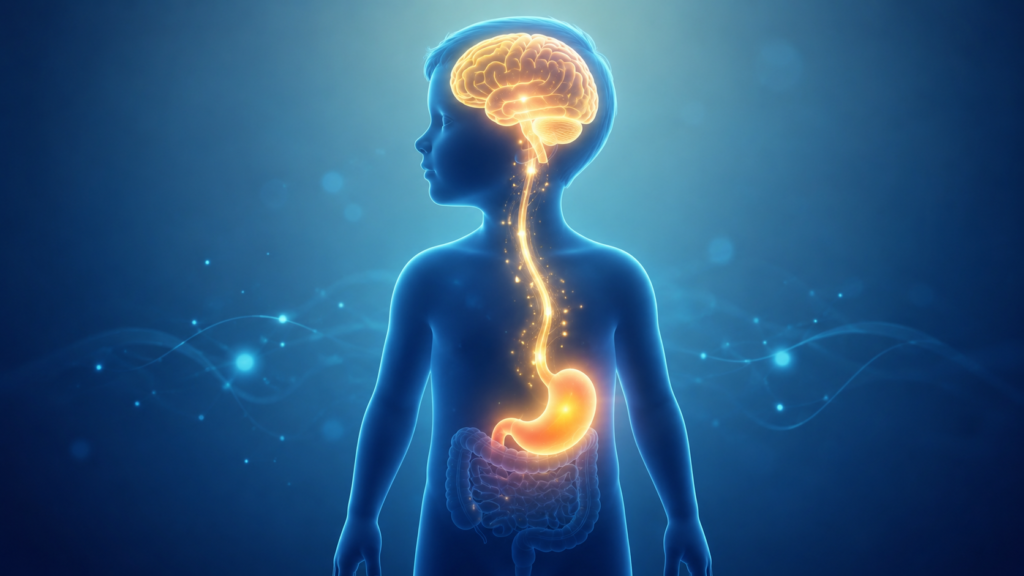
A child complains of stomach pain. It comes and goes — sometimes severe enough to stop them mid-play, sometimes accompanied by nausea or vomiting. Blood tests come back normal. An ultrasound shows nothing. The pediatrician reassures the parents that it’s probably nothing serious. The pain keeps coming back anyway.
This pattern is more common than most parents realise, and it has a name that rarely comes up in the initial conversation: abdominal migraine.
What Abdominal Migraine Actually Is

Abdominal migraine is a recognised migraine variant that presents as recurrent episodes of moderate to severe abdominal pain — typically centred around the belly button — rather than head pain. Episodes are usually accompanied by nausea, vomiting, loss of appetite, and sometimes a pale, washed-out appearance. A defining feature is that the child is completely well between episodes. This is not a chronic stomach ache; it is a distinct, episodic pattern with clear symptom-free intervals.
The condition most commonly affects children between the ages of 2 and 10, though it can occur in adolescents and, less commonly, adults. It sits within a broader category called functional gastrointestinal disorders — conditions where the gut and the nervous system are believed to interact in ways that produce real physical symptoms without an identifiable structural or biochemical cause on standard testing.
The underlying mechanism is thought to be closely related to conventional migraine — involving similar neurological and vascular processes, just manifesting in the abdomen rather than the head. This is not “in the child’s head” in the dismissive sense some parents fear when a diagnosis has no clear physical marker. It reflects a genuine neurological process that current medicine understands incompletely but recognises as real.
Why This Diagnosis Gets Missed So Often
A 2025 systematic review analysing 662 patients across 63 studies found that abdominal migraine is frequently misdiagnosed or overlooked entirely. The reasons are practical and understandable.
Young children often struggle to describe their symptoms with the precision adults can. A child experiencing abdominal migraine may simply say their tummy hurts — the same words used for a stomach bug, constipation, or anxiety-related discomfort. Distinguishing between these based on a child’s own description alone is genuinely difficult.
The diagnosis also falls at the intersection of several specialities. A child with recurrent abdominal pain is typically first evaluated by a pediatrician or a pediatric gastroenterologist, since the presenting complaint is abdominal. Pediatric neurologists, who are more likely to recognise the migraine features of the pattern, are often not involved unless the gastrointestinal work-up comes back clear and someone specifically considers a neurological cause.
A separate 2025 study examining diagnostic criteria for abdominal migraine concluded that the existing symptom-based checklists lack sufficient specificity to distinguish it reliably from other functional gastrointestinal disorders. In practice, this means diagnosis requires a clinician who is specifically looking for the pattern — not simply ruling out other conditions and stopping there.
The consequence of this diagnostic gap is not trivial. Children with unrecognised abdominal migraine often go through repeated medical consultations, unnecessary blood tests, imaging, and in some documented cases, exploratory surgical procedures — all in search of an explanation for pain that follows a recognisable, treatable pattern the whole time.
The Indian Picture: Long Delays Before Diagnosis
The broader pattern of delayed headache and migraine recognition in Indian children provides useful context. A study of school-going children found that 66.4% reported experiencing headache — a striking figure, though not all of these represent migraine specifically. More tellingly, a study conducted at a Delhi hospital found that among children eventually diagnosed with migraine, 69.2% had been experiencing symptoms for one to two years before presenting for medical evaluation.
This delay reflects several intersecting factors: headache and recurrent pain in children are often normalised by families as something that will pass, access to pediatric neurology expertise is limited in many settings, and the symptom pattern itself — episodic, resolving completely between episodes — can make it seem less urgent than it actually is from a diagnostic standpoint.
For abdominal migraine specifically, this delay is compounded by the fact that the presenting complaint doesn’t obviously point toward a neurological cause at all. A parent bringing a child in for stomach pain is unlikely to expect, or be offered, a migraine-related explanation unless a clinician specifically raises it.
What Happens as These Children Grow Up
Here is the part of the story that matters most for long-term understanding, and it comes with both reassurance and an important caveat.
The reassuring part: abdominal migraine is generally not a lifelong condition in its original form. Approximately 60% of affected children outgrow the abdominal pain pattern by their late teenage years. For many families, this means the condition resolves on its own as the child grows older, without requiring ongoing management into adulthood.
The caveat: up to 70% of children with abdominal migraine go on to develop conventional migraine — the head-pain form most people associate with the word — later in life. The abdominal presentation in childhood, in other words, is frequently not a standalone episode of childhood discomfort that simply disappears. For a majority of affected children, it represents an early expression of a migraine tendency that re-emerges in a different, more familiar form during adolescence or adulthood.
This matters for how families think about the diagnosis. A child who outgrows abdominal migraine by 14 has not necessarily left migraine behind entirely — they may simply be between chapters of the same underlying pattern.
What Diagnosis and Management Actually Involve

Diagnosis of abdominal migraine is one of exclusion — meaning other causes of recurrent abdominal pain need to be ruled out first. This typically involves basic blood work, assessment for coeliac disease and other gastrointestinal conditions, and imaging where clinically indicated, to exclude structural causes. There is no single definitive test that confirms abdominal migraine on its own; the diagnosis rests on a recognisable pattern combined with the exclusion of other explanations.
Once other causes have been reasonably excluded, and the episodic pattern with symptom-free intervals is clearly established, abdominal migraine becomes the appropriate working diagnosis — not a default explanation reached only after every other test has failed, but a specific clinical pattern actively considered alongside other possibilities from the outset.
Management typically follows an approach adapted from conventional migraine treatment, since no treatment protocol has been developed and validated specifically for abdominal migraine. This includes identifying and managing potential triggers — which in pediatric populations often include stress, irregular sleep, and skipped meals — alongside symptomatic treatment during episodes and, for frequent or severe cases, preventive medication under specialist guidance.
What Parents Should Know
If a child has recurrent episodes of moderate to severe abdominal pain — particularly around the navel, accompanied by nausea or vomiting, lasting a few hours to a couple of days, with the child returning to complete normalcy between episodes — this pattern is worth raising specifically as a possible migraine variant, not just a digestive issue.
It is reasonable and appropriate to have other causes properly excluded first. But if standard gastrointestinal investigations come back clear and the pattern persists, asking directly whether abdominal migraine has been considered is a reasonable and informed question for a parent to bring to a pediatrician or pediatric neurologist.
A family history of migraine is a relevant detail worth mentioning during evaluation — abdominal migraine has a recognised association with family history of migraine in a parent or sibling, and this connection can support the diagnosis when other testing is inconclusive.
The Bottom Line
A child’s recurring, unexplained stomach pain is not always a digestive mystery. For a meaningful number of children, it is a form of migraine — one that current diagnostic practice frequently misses because it doesn’t look like the headache most people associate with the word.
Most children outgrow the condition. A significant proportion go on to experience conventional migraine later in life. Both facts matter for how a family understands what they’re dealing with, and for the specialist conversations worth having along the way.
A child repeatedly told their pain has no cause may not be facing an absence of explanation. They may simply be facing one nobody has looked for yet.
📚 References:
Paydaş AB, Yücel A, Güven AS. Turkish Journal of Pediatrics, 2025.
Systematic review of 662 abdominal migraine patients. PubMed Central, 2025.
Malik et al. School-going children headache prevalence study, India.
Recurrent headache in pediatric outpatients, Delhi. Indian Pediatrics, 2013.
Migraine at School / Children’s Health — outgrowth and progression to conventional migraine, 2024–2025.
For evaluation of recurrent abdominal pain, headache, or migraine in children, SDDM Hospital’s Paediatrics and Neurology departments are available at +91-191-2464637 or sddm.hospital.
This article is for general educational purposes and does not constitute medical advice. Please consult a qualified healthcare professional for individualised assessment and guidance.
SDDM Hospital, Jammu Multi-Specialty Care | Paediatrics | Neurology 📍 Channi Himmat, Jammu | 📞 +91-191-2464637 | 🌐 sddm.hospital
If you have a child health concern, consult our Pediatrics department at SDDM Hospital, Jammu.
