

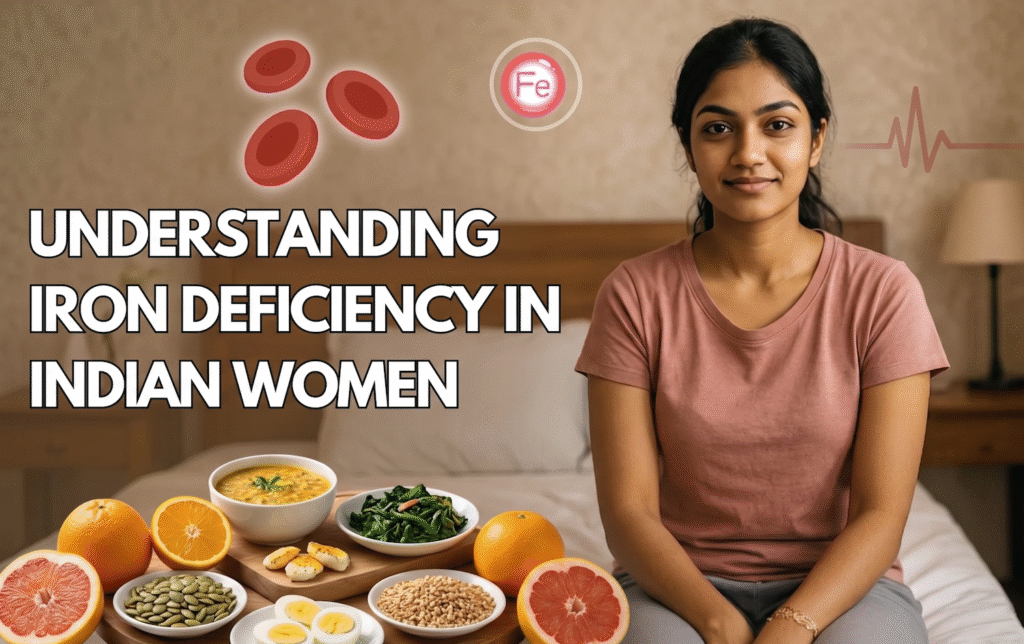
More than half of Indian women aged 15 to 49 are anaemic. That number comes from the National Family Health Survey — the largest, most authoritative health survey in the country. It has been measured repeatedly, across decades, with full government awareness.
It has also been getting worse.
Between NFHS-4 (2015–16) and NFHS-5 (2019–21), anaemia prevalence among women of reproductive age rose from 53% to 57%. This happened despite the Anaemia Mukt Bharat campaign launched in 2018, despite iron supplementation programmes that have existed since 1970, and despite the condition being one of the most discussed public health problems in Indian medicine.
The programmes are not absent. The results are not improving. That gap deserves a clear-eyed explanation.
What Iron Deficiency Actually Is — and Why It Is Not Just About Blood Count
Most people, when they think about iron deficiency, think about anaemia — low haemoglobin, pale skin, breathlessness. This is the most visible end of the spectrum.
But iron deficiency exists on a continuum. It begins with depleted iron stores in the body — measurable through a blood test called serum ferritin — long before haemoglobin levels fall. A woman can have a completely normal haemoglobin reading and still be significantly iron deficient. Her blood count looks fine on paper. Her body’s iron reserves are running low.
This stage — iron deficiency without anaemia — is estimated to be at least twice as prevalent as iron deficiency anaemia. A 2024 cross-sectional study confirmed that screening by haemoglobin alone misses substantial iron depletion in women with normal blood counts.
The symptoms at this stage are real and measurable: persistent fatigue that does not resolve with rest, difficulty concentrating, reduced physical stamina, increased susceptibility to infection, and in some cases hair thinning. These symptoms are frequently attributed to stress, workload, sleep deprivation, or simply “being busy.” They rarely trigger an iron investigation — because the haemoglobin, when checked, is normal.
By the time haemoglobin falls and anaemia is diagnosed, iron stores have been depleted for considerably longer. The intervention arrives late.
Why the Indian Diet Makes This Harder
Iron in food comes in two forms. Haem iron — found in meat, poultry, and fish — is absorbed efficiently by the body, at rates of 15–35%. Non-haem iron — found in plant sources including lentils, spinach, fortified cereals, and legumes — is absorbed at a rate of just 2–20%, depending on what else is consumed alongside it.
The dominant Indian diet is cereal-based and largely vegetarian. This means the primary iron source for most Indian women is non-haem iron — the form the body absorbs least efficiently.
But the absorption problem does not stop there.
Phytates — compounds found in high concentrations in rice, wheat, and legumes, which are staple components of Indian meals — directly inhibit non-haem iron absorption. They bind to iron in the digestive tract and prevent it from crossing into the bloodstream. A meal that appears nutritionally rich in iron may be delivering a fraction of its theoretical iron content because of phytate interference.
Then there is tea. India is one of the world’s largest tea-consuming nations. Tea contains polyphenols — specifically tannins — which are potent inhibitors of iron absorption. Consuming tea with or immediately after a meal can reduce iron absorption from that meal by up to 60–70%. This is not a marginal effect. For a woman relying on non-haem iron from a vegetarian meal, drinking tea with lunch or dinner may functionally negate a meaningful portion of the iron she consumed.
The combination — low bioavailability iron sources, phytate inhibition from staple foods, and tannin interference from habitual tea consumption — creates a situation where dietary iron intake may look adequate on paper while actual absorbed iron is severely insufficient.
Why Supplementation Alone Keeps Falling Short
The standard response to iron deficiency in India has been iron supplementation — iron tablets distributed through government programmes, prescribed at clinics, and recommended across the health system.
Supplementation works when it is taken consistently and when absorption is not obstructed. The evidence suggests both conditions are frequently unmet.
A KAP (knowledge, attitudes, and practices) survey administered across six Indian states by FOGSI found that while 79.8% of women supported iron supplementation in principle, only 29.5% reported regular treatment practices. Adherence is low — partly due to side effects (nausea, constipation) that make consistent use difficult, and partly due to limited understanding of why regular dosing matters.
More fundamentally, supplementation addresses the deficiency without addressing the absorption barriers that created it. An iron tablet taken with tea, or as part of a high-phytate meal, has reduced bioavailability. A supplement without dietary counselling is a partial solution.
Food fortification — adding iron to widely consumed staple foods at the production level — is the most effective population-level intervention for iron deficiency globally. In India, fortification of rice, wheat flour, and edible oil is permitted and encouraged under FSSAI guidelines. Implementation remains inconsistent. The infrastructure exists. Uptake has not been uniform.
The result is a system that has prioritized tablet distribution while leaving the structural absorption barriers largely unaddressed.
Who Is Most at Risk — and What a Complete Assessment Looks Like
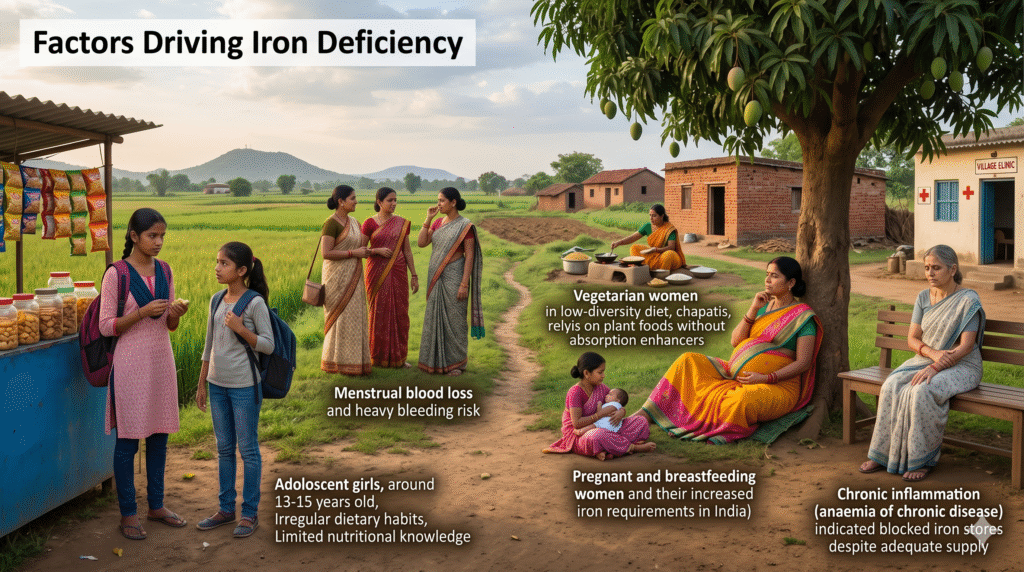
Iron deficiency in Indian women is not evenly distributed. The groups at highest risk include:
Adolescent girls — rapid growth combined with the onset of menstruation creates a significant iron demand at exactly the age when dietary habits are often irregular and nutritional knowledge is limited.
Women of reproductive age — monthly menstrual blood loss is the single largest driver of iron deficiency in this group. Women with heavy menstrual bleeding — a condition that often goes undiagnosed or undertreated — are at substantially higher risk.
Pregnant and breastfeeding women — iron requirements increase significantly during pregnancy. NFHS-5 data shows 52.2% of pregnant women in India are anaemic.
Vegetarian women in low-diversity diets — reliance on a narrow range of plant foods without deliberate inclusion of absorption enhancers significantly increases deficiency risk.
Women with chronic inflammation — inflammatory conditions elevate a protein called hepcidin, which blocks iron absorption and release. These women may have adequate iron stores but cannot access them effectively — a condition called anaemia of chronic disease that requires a different clinical approach from iron deficiency anaemia.
A complete assessment of iron status requires more than a haemoglobin measurement. Serum ferritin reflects iron stores and is the earliest indicator of depletion. Serum iron, total iron-binding capacity, and transferrin saturation together provide a fuller picture. In cases where inflammation may be affecting ferritin levels — ferritin is an acute-phase protein and rises with inflammation regardless of iron stores — C-reactive protein should also be checked to interpret ferritin correctly.
This panel is not complex. It is not expensive relative to the clinical cost of missed or undertreated deficiency. But it requires a clinical approach that looks beyond haemoglobin.
What Treatment Actually Involves
For confirmed iron deficiency, oral iron supplementation remains the first-line treatment — but the form, timing, and dietary context all affect outcomes.
Iron is best absorbed on an empty stomach, with a source of vitamin C (orange juice, amla, lemon water) which significantly enhances non-haem iron absorption. It should not be taken with tea, coffee, calcium supplements, or antacids — all of which impair absorption. For women who experience significant gastrointestinal side effects, alternate-day dosing has been shown in some studies to achieve similar serum ferritin increases with better tolerance.
For women with severe deficiency, malabsorption conditions, or who do not respond adequately to oral iron, intravenous iron infusion is an effective and increasingly accessible alternative that bypasses gut absorption entirely.
Dietary changes — incorporating vitamin C rich foods with iron-containing meals, reducing tea consumption immediately post-meal, and where possible diversifying protein sources — are not replacements for supplementation in frank deficiency, but they are meaningful long-term supports that determine whether the deficiency recurs once treated.
The Bottom Line
Iron deficiency in Indian women is a problem of structural depth — dietary patterns, absorption biology, screening gaps, and implementation failures — not simply one of awareness or access to iron tablets.
The woman who is told her haemoglobin is normal, given no ferritin test, and sent home with fatigue she attributes to a busy life may be iron deficient. The woman who takes iron tablets irregularly because nobody explained that tea with dinner reduces their effect is not failing to comply — she is failing to receive complete information.
Better outcomes begin with a fuller picture. That requires ferritin alongside haemoglobin, dietary context alongside supplementation, and a clinical conversation that accounts for the specific nutritional reality of Indian women’s lives.
The problem has not lacked attention. It has lacked the right kind.
📚 References:
Sharif N et al. PLOS ONE, 2023.
National Family Health Survey-5. Ministry of Health & Family Welfare, 2021.
Pasricha SR et al. Nutrients, 2024.
FOGSI KAP Survey. PubMed Central, 2024.
Thankachan P et al. Frontiers in Nutrition, 2022.
Zimmermann MB, Hurrell RF. Lancet, 2007. (nutritional iron deficiency)
For assessment of iron status, anaemia, and related concerns, SDDM Hospital’s Gynaecology, Internal Medicine, and Laboratory Services teams are available at +91-191-2464637 or sddm.hospital.
This article is for general educational purposes and does not constitute medical advice. Please consult a qualified healthcare professional for individualised assessment and guidance.
SDDM Hospital, Jammu Multi-Specialty Care | Gynaecology & Women’s Health | Internal Medicine | Pathology & Laboratory Services 📍 Channi Himmat, Jammu | 📞 +91-191-2464637 | 🌐 sddm.hospital
If you have a women’s health concern, consult our Gynecology department at SDDM Hospital, Jammu.
